
Insights
A starter guide to SEO for business owners
What SEO actually is, what it involves, and what it takes to do it properly.
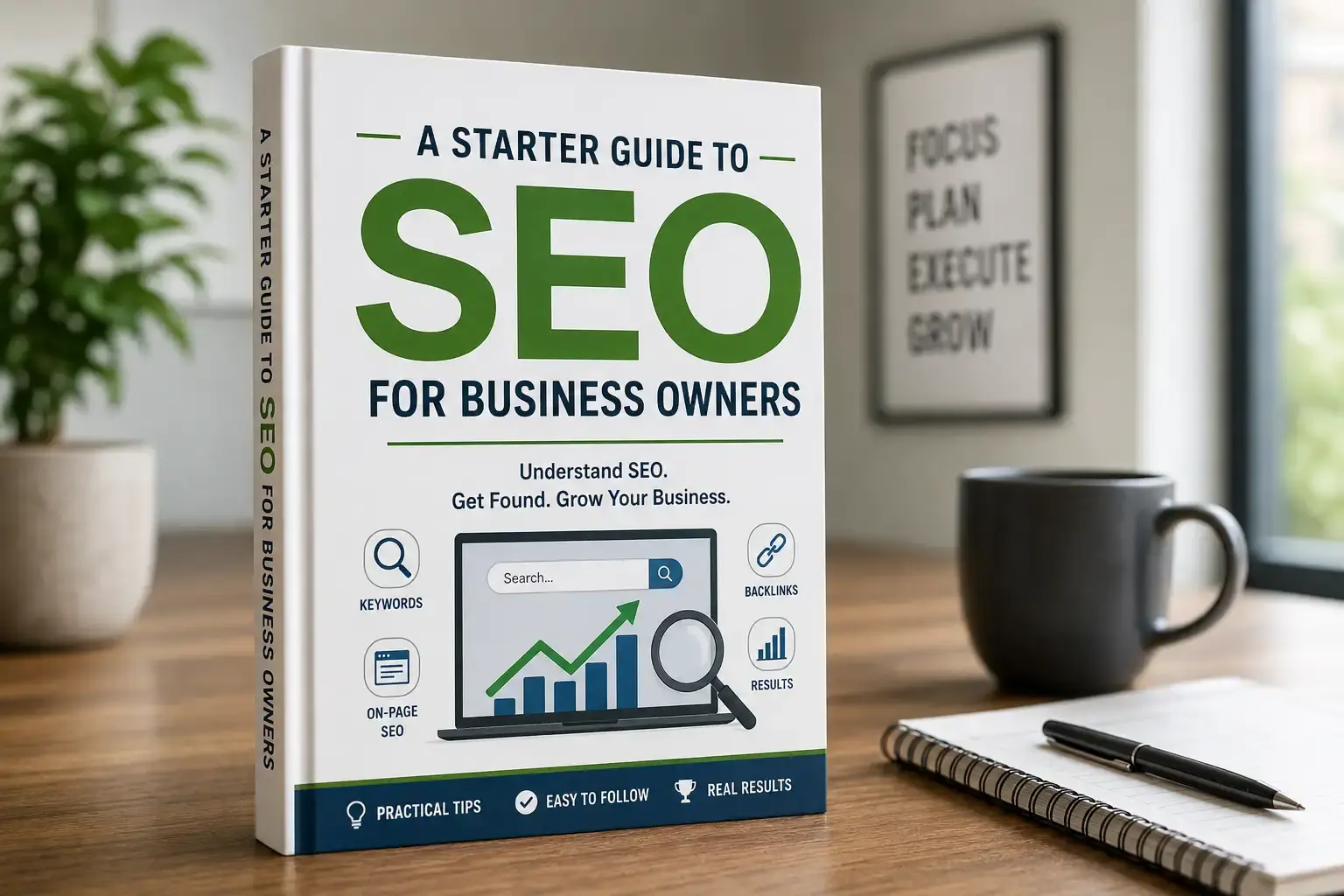
If you own a business with a website, you've almost certainly received the emails. Subject lines like "Your Google ranking is at risk" or "I noticed some issues with your SEO" from someone named Brad at a company you have never heard of. The vast majority are junk - but buried underneath the spam-flavoured marketing tactics is a question worth asking: does your website have SEO issues? Could it be ranking better? What is SEO anyway, and what exactly am I ranking for?
SEO is one of the most talked-about things in digital marketing and unfortunately also one of the least clearly explained. This is a plain-language, jargon-free walkthrough of what search engine optimization involves, what each piece does for your business, and what it realistically takes to get it working.
SEO is not a switch you can flip.
Meaningful movement usually takes three to six months. Anyone promising page-one results in two weeks is selling you something rotten.
What is SEO, and why does it matter?
SEO stands for search engine optimization. In plain terms, it's the work that helps your business show up in search results when someone types something relevant into Google, Bing, and so on. Since Google holds roughly 90% of the search engine market, this article focuses on Google - but SEO best practices are universal across search engines, even if some of the specific tools aren't.
When a potential customer searches for "plumber in Barrie" or "best accountant Toronto" or "where to buy X," Google decides which businesses and pages to show them, and more importantly, in what order. SEO is the process of making sure your business is one of the ones it shows, as close to the first search result as possible.
It matters because most people click on the first few results and rarely go further. If your business is buried on page three or four, most of those potential customers simply never find you. High search visibility means more people landing on your site. More people landing on your site means more opportunities to turn them into customers.
The basics: getting the foundations right
Before any meaningful SEO work can begin, a few fundamentals should be in place first. Think of these like an address label on an envelope. If they're wrong or inconsistent, nothing else works properly.
One name, address, and phone number
Decide on the official version of your business name, address, and phone number and keep it identically consistent everywhere. Google cross-references your business information across dozens of sources, and even small inconsistencies (Street vs St., two different phone formats) undermine how much it trusts you are who you say you are.
One official web address
Your website should have one canonical (official) address (for example, https://www.yourbusiness.com) and every other version of it should automatically redirect there. A site that is split across multiple addresses ends up competing with itself in search results. For example, https://www.yourbusiness.com might forward to https://yourbusiness.com.
A clear sense of who you're targeting
A local service business and a national e-commerce store play completely different games in SEO. Unless you've got money to recklessly burn, trying to rank everywhere typically means ranking nowhere. Knowing your focus early saves a lot of wasted effort later.
Your Google Business Profile: the most underused free tool
A Google Business Profile is one of the most valuable free tools available to any business with a web presence. If you serve a local area, it's especially powerful: it's what puts you in the Google Map results and the short list of nearby businesses that appear at the top of relevant searches. But even businesses that operate nationally or online-only benefit from having a Google Business Profile (GBP), since Google uses it as a trust signal and it appears prominently on the first page of search results when someone searches your business name directly (to see an example, do a Google search for "fifth and missing design group").
You've probably seen it: someone searches "hardware store near me" and Google shows a small map with three or four businesses listed underneath. That section is driven almost entirely by the business's GBP. Businesses without one, or with incomplete or stagnant ones, rarely appear there at all.
A well-maintained GBP includes your correct business category, accurate hours, a clear description of what you do, real photos of your work or space, your services listed individually, and an active response to every review that comes in. Google treats a complete, active GBP as a sign of a legitimate and engaged business. Incomplete profiles tend to underperform.
Reviews are a major factor in local rankings. Businesses with more reviews, more recent reviews, and owners who respond thoughtfully to them (not just the same canned response) rank better than businesses that ignore this. Getting into the habit of asking satisfied customers for a review, and responding to all of them, is one of the simplest and highest-return things a local business can do.
If you'd rather have someone handle this for you, we offer SEO services for local and national businesses. We'd be happy to chat about your SEO requirements by phone or email.
Tracking tools: knowing what's actually working
There are two free tools from Google that provide visibility into your SEO performance. Setting them up properly early is important because they only collect data going forward, not retroactively.
Google Analytics (GA)
Google Analytics shows which pages visitors land on, how long they stay, where they came from, and whether they took the actions that matter to you (filling out a form, calling, making a purchase). Without Google Analytics, you're flying blind. (Did we mention it's free?)
Google Search Console (GSC)
This also-free tool offers insight into what happens inside Google before someone clicks through to your site: the exact searches you appear for, how many people saw your result, how many clicked, and where you rank. It also flags problems that could be hurting your visibility, like pages Google cannot read or security issues on the site.
Together, these two tools tell you what your business shows up for in search and what people do once they arrive. They're the baseline for virtually every SEO decision moving forward.
Technical SEO: the stuff under the hood
Technical SEO covers the behind-the-scenes engineering that determines whether Google can read and trust your site. It's not glamorous, but it is foundational. Even excellent content won't rank well if the site has technical problems working against it.
The main areas are:
- Site speed. Pages that load slowly lose visitors and rankings. This includes compressing images, using modern file formats, cutting out unnecessary code, and loading elements in the right order.
- Mobile performance. Google judges your site primarily by its mobile version because the majority of web traffic now comes from phones. A site that works well on desktop but is awkward on mobile is a problem.
- Secure connection. Your site should always run over HTTPS (that's the padlock icon in the browser). Sites without it are flagged as insecure and Google treats them as less trustworthy.
- Crawlability. Google needs to be able to find and read every page that should appear in search, and be appropriately blocked from pages that should not (admin areas, duplicate content, etc.). A single wrong setting can hide entire sections of a site from search.
- Clean structure. Important pages should be reachable in a few clicks from the homepage, with logical links between related content.
Most of this is invisible to visitors. The average visitor to your site won't notice when it's done right, but they will when it's wrong: slow loads, broken pages, frustrating navigation.
A note worth making here: your website and your SEO are more connected than they might seem at first. A well-built site makes SEO easier and more effective. If your site was built without SEO in mind, you may find that some of this technical work is harder to bolt on after the fact. Our web design work is built with search performance in mind from the start.
On-page SEO: making each page earn its place
On-page SEO is the work of shaping each individual page so it matches what people are actually searching for and clearly answers their question. It covers:
- Meta title. The page title shown in Google results. This is what people read when deciding whether to click. It needs to be specific, honest, and worth clicking (be mindful of the character limit).
- Meta description. The short description below the title. It's another chance to earn the click before anyone even lands on your site. Make it descriptive and relevant to that specific page. So, if the page is about cats, don't mention tractors.
- Headings and content structure. Pages need to be easy to scan, logically organized, and written in plain language that matches how your customers actually talk.
- Keyword alignment. Each page should target a realistic set of search terms that regular people use, not industry jargon. And two pages on the same site shouldn't ever compete for the same terms (this is affectionately referred to as "keyword cannibalization").
- Images. Every image should have a short text description for search engines and screen readers. These descriptions are referred to as "alt text" and are a requirement if your site needs to meet accessibility requirements, such as WCAG or AODA.
When done properly, on-page SEO means each individual page is doing a specific job and doing it well.
Content: becoming a source worth trusting
Google doesn't just rank pages. It tries to identify sources it can trust to give people relevant and reliable information. A business that covers its field thoroughly and accurately, over time, builds more search authority than one with a single polished homepage and nothing else.
This doesn't mean writing blog posts just for the sake of it. It means covering topics your customers actually ask about, in enough depth to be genuinely useful, with the real experience behind it showing. Named authors, honest sourcing, and a clear sense of who is behind the business all factor into how credible Google considers your site to be.
Original content outperforms generic content consistently. If your pages say the same things in the same way as your competitors, they give Google no legitimate reason to prefer you. Real examples, your own expertise, and content that reflects how you actually work and communicate are the things that earn citations, links, and higher rankings.
Content also needs to be maintained. A page that was accurate two years ago and has since gone stale loses ground quietly. Keeping your best pages current is part of the ongoing work.
Building trust off-site: links and citations
Your own site tells Google who you are. The rest of the web tells Google whether to trust you. That means your website needs to get out there and make friends.
Links from other websites
When a respected, relevant website links to yours, it is effectively vouching for you. A handful of quality links from trusted sources is worth far more than hundreds of low-quality or irrelevant ones. These are earned by being genuinely worth linking to: useful content, real industry relationships, local partnerships. Examples include your local Chamber of Commerce, hyper-relevant business directories, event sponsorship placements, Yelp, and so on. Bought links and spammy directories can get a site penalized - so don't.
Consistent business listings
Your name, address, and phone number should appear identically across maps, directories, and industry listings. As with people, inconsistencies confuse Google and reduce its confidence in your business. Getting listed accurately in the right places, and cleaning up any outdated or duplicate entries, is a straightforward but often-overlooked part of local SEO.
Local SEO: showing up for the area you serve
If your business serves a specific geographic area, local SEO is where a lot of the practical work lives. The map results that appear at the top of local searches (the section with the pins) are driven by three things:
- Relevance: how well your listing and pages match what someone searched for.
- Distance: how close you are to the person searching. You can't change this unless you're a wizard, which is why getting your categories and service areas accurate matters so much.
- Reputation: your reviews, your listings around the web, and links to your site.
Genuine area-specific pages help here too. A single generic services page covering your whole region is less effective than pages written specifically about the work you do in specific areas, with local context that is actually meaningful rather than a town name swapped into a template. But remember, avoid cannibalizing. Multiple location-specific pages that all have identical content, other than the location name, means you're just feasting on yourself - and that's not enjoyable.
AI and search: what's changing
If you have used Google lately, you may have noticed that it sometimes shows an AI-written summary above the regular search results. These AI Overviews can answer a question without the person ever clicking a link. Something similar happens on ChatGPT, Perplexity, and other AI tools: they pull information from trusted sources around the web to answer questions.
Getting your business referenced in these answers is increasingly part of what SEO is about. The good news is that the things that earn those references are the same things that earn high rankings: clear and direct answers to real questions, well-organized content, honest sourcing, and a site that demonstrates genuine authority in its field.
There is no industry-proven trick (yet) for showing up in AI answers. It's a natural outcome of doing the foundational work well.
Ongoing SEO: why it never quite stops
SEO is not a one-time project. Rankings shift. Competitors publish new content. Google itself regularly updates how it evaluates sites. Pages that ranked well two years ago can lose ground in a hurry if nobody maintains them.
The ongoing work includes reviewing which searches are trending up or down each month, refreshing content that has gone stale, monitoring for technical issues, keeping the Google listing active, responding to reviews, and - like a nosy neighbour - watching how your local competitors are evolving. None of these tasks are enormous on their own, but skipping them consistently means giving up ground.
The businesses that see the best long-term results from SEO tend to be the ones that treat it as a steady, maintained effort rather than a campaign with a finish line. This is exactly what our SEO services cover, from the initial setup through to the ongoing monthly work. We handle the technical side, the content, the listings, and the reporting, so you can focus on your business. Leave the cats and tractors to us.
Sources & Further Reading
Search engine optimization is the ongoing work of making your business visible to the people searching for what you offer. Done properly, it builds search visibility that compounds over time, brings in customers who were already looking for what you do, and reduces your reliance on paid advertising. It takes consistent effort and it doesn't happen overnight - but for most businesses, it can be one of the better long-term returns on investment available.