
Insights
Vibe coding, AI, and the illusion of “instant software”
AI tools are making software easier to build than ever before.
But that’s not the whole story.
What Is Vibe Coding, and Why Does It Matter for Your Business?
If you’ve been hearing more about AI in business conversations lately, you’re not imagining it. Artificial intelligence, the technology behind tools like ChatGPT, Copilot, and similar platforms, has moved from a tech industry curiosity into something businesses across every sector are now actively exploring.
The rise of vibe coding
By March 2025, Merriam-Webster had listed “vibe coding” as a trending term. By the end of 2025, Collins Dictionary named it Word of the Year.
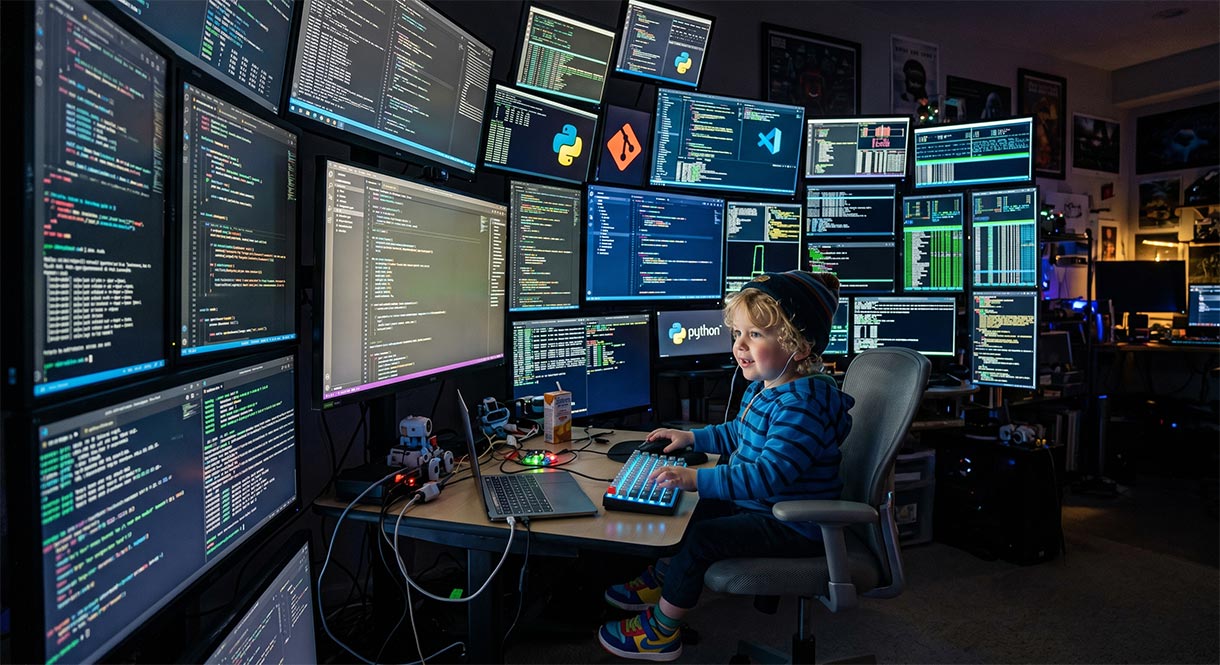
One of the more recent developments coming out of that shift is something called vibe coding. The term was coined in early 2025 by AI researcher Andrej Karpathy, and it describes a way of building software that looks very different from traditional development. Instead of writing structured code line by line, which is how code is traditionally created, a person describes what they want in plain language and an AI tool builds it.
For example, you might say: “I need an internal tool that tracks customer orders and sends a follow-up email after three days.” There are third party tools that already do exactly that but you choose to do it yourself, maybe to save money or because the off the shelf product has too many things you don’t need. So, the AI generates the software. You review it, adjust it, and repeat until it works. No formal programming background required.
The appeal is obvious. A business owner, with no formal experience in development, can move from idea to working tool in hours instead of weeks. Marketing teams can build internal dashboards or automation without waiting on a development queue. Early momentum feels real and exciting, and in many cases it is. Research supports this: AI-assisted development is genuinely accelerating timelines, and some funded startups are now reporting that 95% or more of their codebase is AI-generated.
But speed has a way of hiding what’s underneath.
What Can Go Wrong and Why It Doesn’t Show Up Right Away
The structure problem
AI-generated code is typically built to solve the immediate request. It doesn’t naturally account for how a system will need to grow or change. Over time, this leads to code that works but isn’t easy to follow, features that are layered on top of each other without consistency, and little or no documentation explaining how the pieces connect.
Glide, a software development platform, describes AI-generated codebases as “brittle and poorly organized under the hood”, meaning the code that passes initial tests but accumulates what developers call technical debt quickly. Experienced engineers describe debugging AI-created code at scale as “practically impossible.”
The security problem
This is where things get more serious. AI models learn from vast amounts of publicly available code including outdated, insecure, and flawed code written by developers over decades. When an AI generates new code, it reproduces those patterns, including the vulnerabilities.
The numbers from recent research are hard to ignore. Veracode’s 2025 GenAI Code Security Report, which tested over 100 AI models across 80 different coding tasks, found that AI-generated code introduced security vulnerabilities in 45% of cases and that AI systems chose the less secure approach nearly half the time, even when a more secure option was available. A separate large-scale academic study found that at least 62% of AI-generated programs contained known vulnerabilities.
Research from Apiiro analyzing Fortune 50 enterprises found that AI-assisted code introduced 2.74 times more security vulnerabilities than human-written code, with privilege escalation flaws up 322% and architectural design issues up 153%. By mid-2025, AI-generated code was adding over 10,000 new security findings per month across the repositories they studied, a tenfold increase from just six months earlier.
For a landing page or basic informational site, the risk is relatively low. For any tool that handles customer data, payments, login systems, or internal business information, these are not theoretical concerns. They are documented patterns already appearing in real systems.
The scalability problem
Many vibe-coded tools are built for the moment they’re created. They aren’t designed with growth in mind. As usage increases, businesses start running into performance slowdowns, data handling issues, and systems that weren’t built to support real traffic or real volume. A survey of 18 CTOs conducted in August 2025 found that 16 of them reported production disasters directly caused by AI-generated code, ranging from performance collapses to data corruption to broken subscription systems.
There’s also a compounding dynamic that developers describe consistently: the first few features of a vibe-coded project come together quickly. But each new feature takes longer, because the AI must understand more and more of an increasingly tangled codebase. Eventually, the time spent explaining the existing system to the AI starts to outweigh the time it would have taken to write the code properly in the first place.
The Ownership Problem: What Happens When Nobody Understands How It Works?
There’s another layer to this that doesn’t come up often enough in business conversations.
When a system is built through layered prompts and AI output, there’s often no clear understanding of how it actually works internally. This becomes a real problem the moment something breaks or the moment the person who built it is no longer available (colloquially referred to as HBB, or hit-by-a-bus scenario). In the latter case, if the one person who understands the system is suddenly unavailable, the business is left with something that runs but that nobody can explain, maintain, or safely modify.
At that point, businesses often find themselves:
- Spending significant time trying to reverse-engineer their own tools
- Bringing in developers who inevitably recommend partial or full rebuilds
- Losing the time they originally saved, and then some
The irony is that the appeal of vibe coding is speed and cost savings. But when the hidden costs of fixing, rebuilding, and managing insecure or unmaintainable systems are added up, those early savings often disappear. For many businesses, the outcome is that they spend just as much time and money (sometimes more) than if they had worked with experienced professionals from the start.
When Vibe Coding Actually Works
Vibe coding and AI-driven development can be useful when the scope is clear. They work well for:
- Prototyping ideas quickly before committing to a full build
- Testing internal workflows before investing in proper development
- Supporting experienced developers, helping them move faster on certain tasks
- Reducing repetitive or time-consuming work that doesn’t require custom logic
The strongest vibe-coded projects tend to be small, tightly scoped or overseen by experienced developers. That oversight helps catch architectural mistakes before they spread through the codebase.
How We Approach This at Fifth & Missing Design Group
We use AI where it can save time, but our developers and designers remain responsible for every project. They review the structure, test the work and consider how the system may need to change six months or two years after launch.
Structural problems often stay hidden until a site grows, needs a new feature or faces a security issue. We account for maintenance, scale and security from the beginning so future work doesn't become needlessly expensive.
Clients work with people who learn what the business needs, ask follow-up questions and take responsibility for the result. AI supports the work; our team owns the outcome.
What's the future of vibe coding?
Vibe coding is making it easier for people to turn ideas into working prototypes. That’s useful for testing a concept, exploring an internal workflow or helping an experienced team move faster.
We still don't know how well many of these systems will hold up as they grow. Research on security, maintenance and scalability is moving more slowly than adoption, and plenty of businesses haven't yet had to expand or repair what they built.
For now, businesses should match the tool to the job, involve experienced people where the stakes are higher and plan for what happens after launch.
Sources & Further Reading
- Veracode: 2025 GenAI Code Security Report — sdtimes.com
- Apiiro: 4x Velocity, 10x Vulnerabilities — apiiro.com
- Glide: Top 5 Problems with Vibe Coding — glideapps.com
- Bisztray et al. (2024): How Secure Is AI-Generated Code? — arxiv.org/abs/2404.18353
- Final Round AI: CTO Survey on Vibe Coding in Production, August 2025
- Collins Dictionary: Word of the Year 2025 — collinsdictionary.com
Vibe coding is most useful when experienced people remain responsible for the decisions and the finished product.