
Insights
What is UCP, and why should every ecommerce business owner be paying attention?
Google just changed how AI assistants buy things on behalf of your customers.
Here’s what that means for your store.
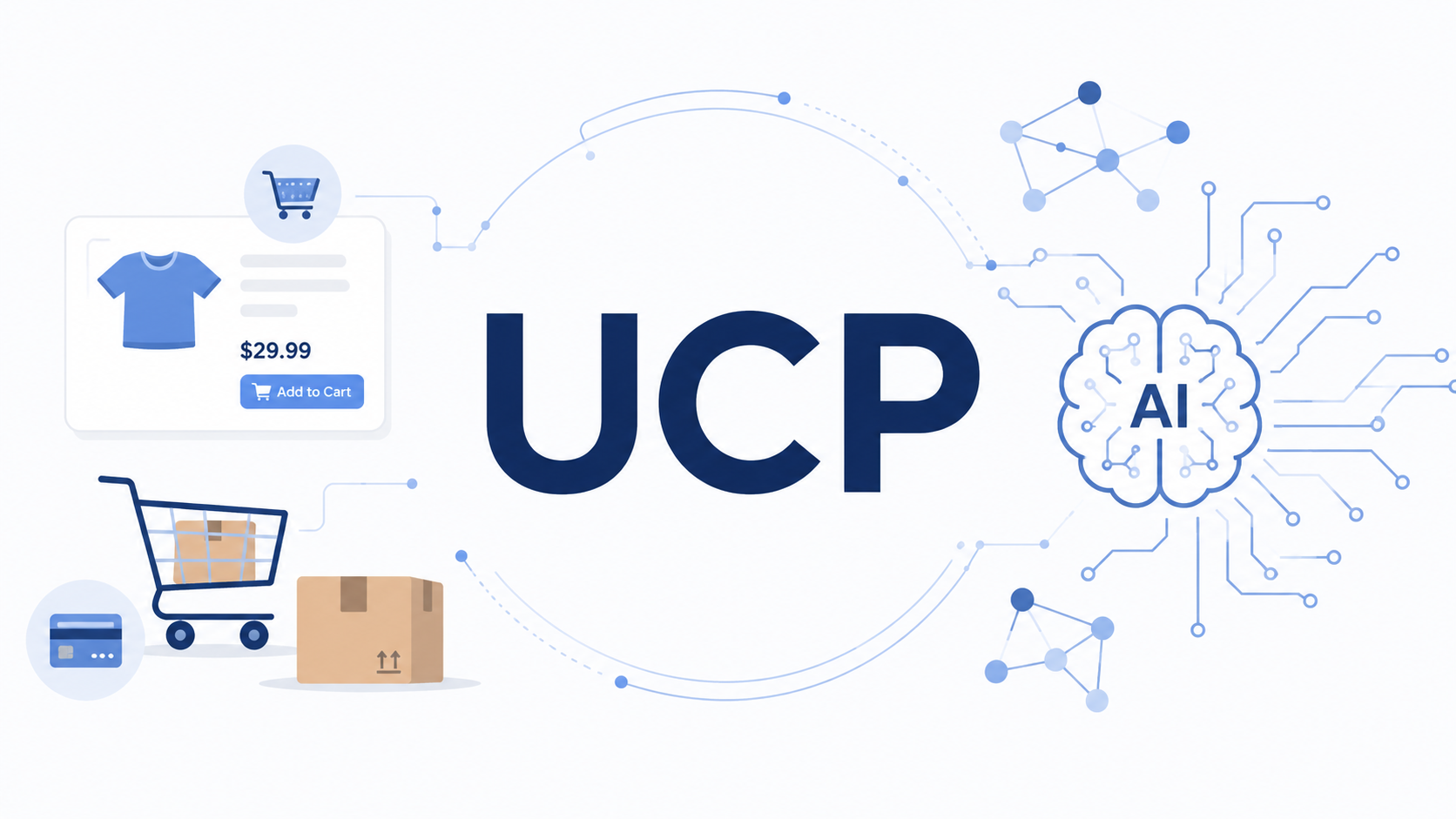
If you sell products online, something important shifted in the first few months of 2026. It happened quietly. The kind of change that shows up in how commerce infrastructure works before it shows up anywhere a customer would notice.
That shift is called the Universal Commerce Protocol, or UCP. It sounds like something that lives entirely in the world of developers and tech teams, but its real-world impact is on ecommerce design, product data, selling, and whether your store gets recommended or gets skipped entirely when someone uses an AI assistant to shop.
Think of it as a common language between AI and your store
UCP is a shared set of rules that lets AI agents read your catalog, build a cart, apply loyalty benefits, and process a transaction.
Here’s the simplest way to understand UCP
When someone asks Google’s Gemini, “find me a waterproof winter jacket under $200,” the AI doesn’t just pull up a list of links. It can now actively browse product inventories, check live pricing, compare options, and complete the purchase if the shopper gives the go-ahead. No visiting your website. No browsing your category pages. No filling in a checkout form.
For that to work, there has to be a standardized way for the AI to talk to your store. That’s what UCP is: an open protocol that tells AI agents how to read your product catalog, build a cart, apply loyalty benefits, and process a transaction.
Google co-developed it with some of the biggest names in commerce, including Shopify, Walmart, Target, Visa, Mastercard, and Stripe, along with over 20 other partners. It launched in January 2026 with basic checkout capability, and in March 2026 it expanded to include multi-item cart support, real-time product catalog access, and loyalty and identity linking.
The shopper may never visit your website and still buy from you
This is the part that matters for most business owners.
For years, the job of ecommerce design and development has been to build a great website: clear product pages, a smooth checkout flow, fast load times, good photography. All of that still matters. But UCP introduces a scenario where a sale can start and finish entirely inside an AI assistant, without the customer ever loading your storefront.
If your store is connected to UCP, an AI agent can find your products, confirm availability, and check out on the shopper’s behalf. If your store isn’t connected, or if your product data is inconsistent, incomplete, or structured in a way the AI can’t read, the agent skips you. The quality of your products is irrelevant if the AI can’t understand your store.
The stakes here are real. Think about how shopping behavior has shifted in the past decade. People went from physical stores to websites to mobile apps to social commerce. Every time the channel changed, the businesses that adapted early captured more of the opportunity. UCP follows the same pattern.
The five things UCP can do
As of the March 2026 update, UCP has five main capabilities. You don’t have to support all of them, but understanding what they are helps clarify what’s at stake:
- Checkout. An AI agent can initiate and complete a purchase on a shopper’s behalf, including guest checkout and standard payment flows.
- Cart. Agents can add multiple products to a cart in a single session, rather than being limited to one item at a time.
- Product catalog access. Agents can pull live product details from your store, including variants, inventory, and pricing, in real time.
- Order management. After a purchase, agents can retrieve order status and tracking information on the customer’s behalf.
- Identity linking. Shoppers can carry loyalty benefits, member pricing, and shipping perks into the agentic experience.
One important detail: retailers remain in control of the customer relationship. UCP handles the communication layer. Your customer data stays with you.
What a business owner actually needs to think about
You don’t need to understand the code behind UCP to understand its implications for your ecommerce business. The decisions it creates are mostly about data quality, setup, and visibility.
Your product data needs to be accurate and consistent everywhere
An AI agent shopping on behalf of a customer is far less forgiving than a human browsing your site. If your return policy isn’t clearly documented, the agent loses confidence. If your product IDs in Google Merchant Center don’t match your checkout system, the transaction can fail. If your pricing or inventory is inconsistent across your site and your product feed, the agent flags it and moves on. The standard for data quality just got higher.
Your Google Merchant Center account matters more than ever
UCP-powered checkout currently runs through Google Merchant Center. If you’re selling online and you don’t have a properly configured account with current return policies, support information, and accurate product listings, you’re not in the game. If you do have one, it’s worth auditing it now.
Your website’s structured data is no longer optional
Structured data is the markup on your product pages that tells search engines, and now AI agents, what a product is, what it costs, whether it’s in stock, and what the conditions of sale are. It’s been quietly important for years. With agentic commerce, it becomes a direct factor in whether your products surface in AI-driven shopping recommendations.
A sale might happen that your analytics never sees
When a sale is completed through a UCP-enabled AI agent, it doesn’t generate a pageview, a session, or a conversion event in Google Analytics. The transaction happens at the API level. Your current reporting may not capture it. This is a known gap, and it’s worth raising with whoever manages your website and analytics now, rather than six months from now when you’re trying to reconcile numbers.
UCP is vendor-agnostic by design. Google is first to bring it to scale, but it won’t be the last.
UCP is bigger than Google
UCP is vendor-agnostic by design. Any AI platform, any retailer, and any payment provider can adopt it. OpenAI and others are pursuing similar initiatives. The direction of travel across the industry is the same: AI assistants handling more of the shopping journey on behalf of users.
The businesses getting ready now are the ones building on solid ecommerce foundations: clean product data, consistent information across every channel, well-structured sites, and a clear understanding of how their store looks to systems that aren’t human.
How this connects to the work we do
At Fifth & Missing Design Group, we build ecommerce sites and custom Shopify stores around accurate product data, clear site structure and a checkout that works well for customers. Those same fundamentals also help automated systems understand a store.
UCP gives retailers another reason to keep their catalogues and technical setup in order. Stores with reliable product information and properly configured feeds will be easier for AI shopping tools to use.
If you want to know whether your store is ready, we can review its product data, Merchant Center setup and page structure. Give us a call or send an email and we'll talk through what needs attention.
Sources & Further Reading
Stores with clean data, accurate product information and a durable technical foundation will be better prepared for agentic commerce.