
Veeva vs IQVIA OCE, compared by a Canadian agency certified in both.
Two platforms dominate life sciences customer engagement. Here's how they differ, and how to tell which one fits your team, without the sales pitch from either vendor.
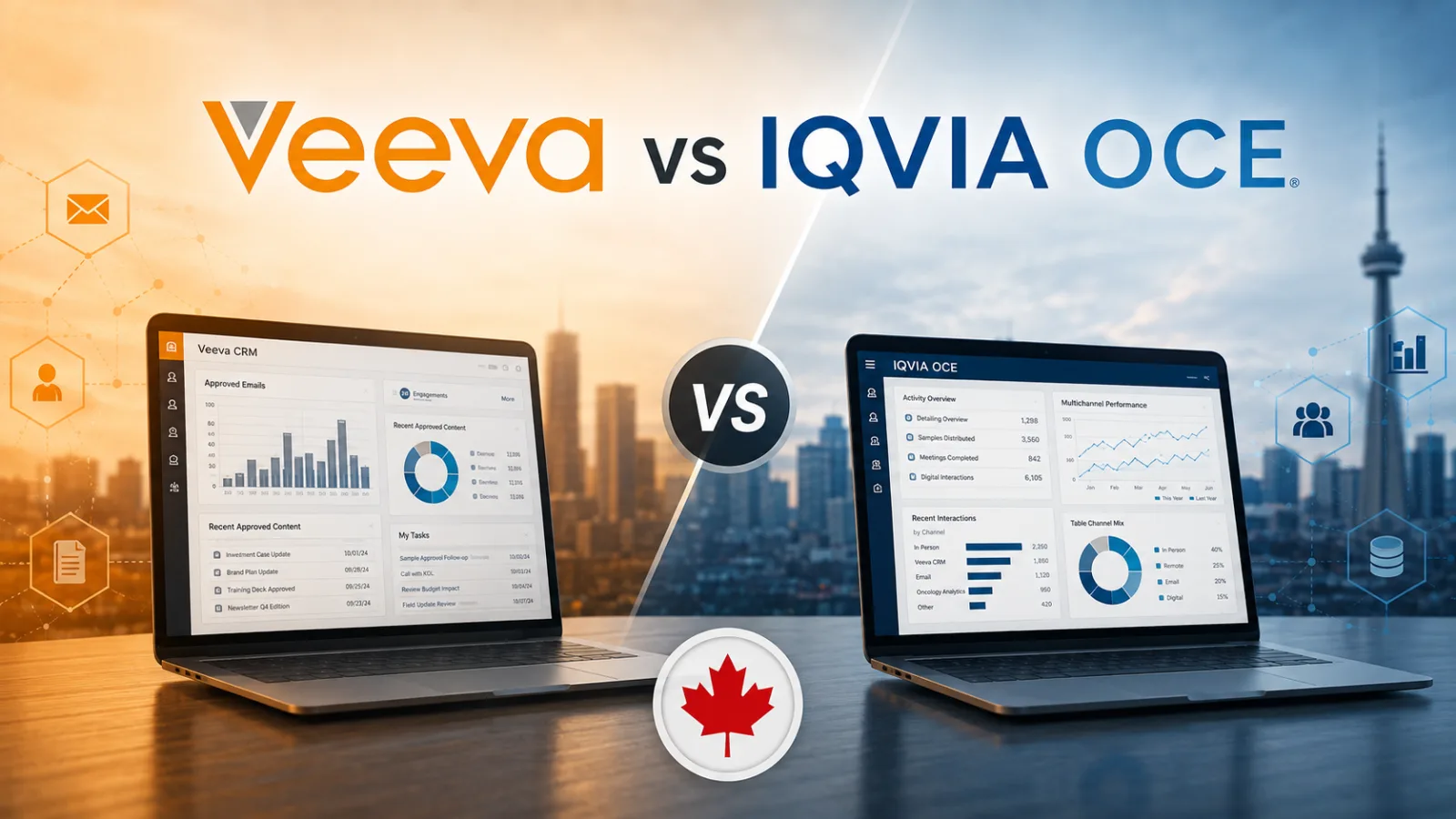
If you're choosing between Veeva and IQVIA OCE, most of the comparisons you'll find are written by someone with a stake in the answer: one of the two vendors, or an agency certified in only one of them. Fifth and Missing Design Group is a Canadian agency certified to build content for Veeva and IQVIA OCE, one of the few in Canada that is. We work on each of them every week, so this is the comparison we wish existed when clients ask us which one they should be on.
Both are strong platforms that will do the job for most pharma, biotech, and medical device teams. The right answer depends far more on your existing systems, your data strategy, and your budget than on any single feature, and there are a few things Canadian teams should weigh before deciding.
If you want the two-line version
Lean Veeva if you're already in the Veeva ecosystem (Vault, PromoMats, Medical) and want everything under one roof. Lean IQVIA OCE if data, analytics, and next-best-action intelligence are central to your commercial model, or you're already invested in IQVIA data. Either way, the content has to be built specifically for the platform you land on, which is the part we handle.
What Veeva is now
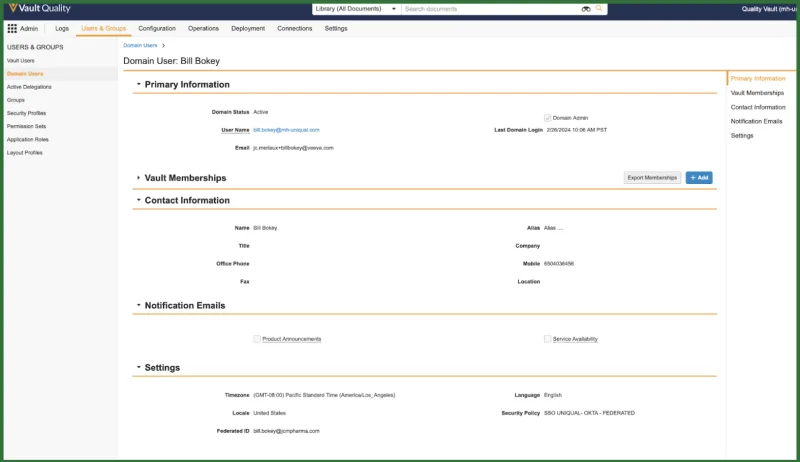
Veeva is the incumbent in life sciences software. Its legacy CRM ran on Salesforce for years; the current product, Vault CRM, runs on Veeva's own Vault platform, and customers are moving to it now. Veeva's main advantage is the surrounding ecosystem. Vault CRM sits next to PromoMats (content and MLR), Medical, and the rest of the Vault suite, so content, approval, and field deployment all live in one connected system.
For a marketing team, that usually means less friction between content getting approved in PromoMats and content going live on the rep's iPad. If you already run on Veeva Vault, staying with Veeva for CRM and CLM is usually the simplest route.
What IQVIA OCE is
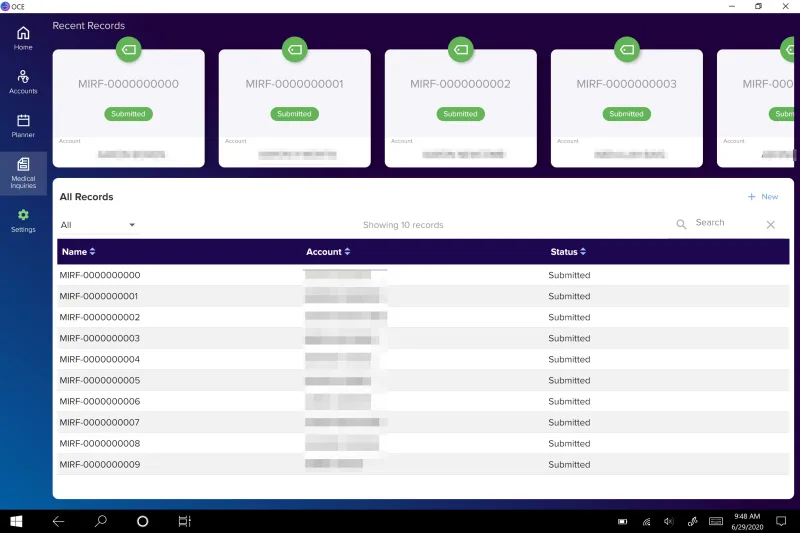
IQVIA Orchestrated Customer Engagement (OCE) is built on the Salesforce platform and backed by what IQVIA is known for: data. IQVIA is a data and analytics company first, and OCE reflects that, with close ties to its proprietary healthcare data, prescription analytics, and an embedded layer that surfaces next-best-action recommendations for field teams.
OCE is designed to connect sales, marketing, and medical around a shared, data-driven view of each customer, which is what the "orchestrated" in the name refers to. If your commercial strategy leans on analytics and targeting, and especially if you already license IQVIA data, OCE can be the more natural fit.
Veeva's move off Salesforce
Any comparison in 2026 has to account for how much is changing. For roughly 15 years, Veeva CRM ran on Salesforce. In December 2022, Veeva said it would not renew that agreement, which expires in 2025, and would build its own CRM on the Vault platform instead. Vault CRM became generally available in April 2024, and every customer still on the Salesforce-based Veeva CRM has to migrate to Vault CRM by 2030. So when people say "Veeva runs on Salesforce," they're talking about the product being retired, not the one Veeva sells today.
Salesforce, meanwhile, is coming back into pharma from the other side. Its Life Sciences Cloud, announced in 2024, is built on IQVIA's OCE technology. So the platform Veeva just walked away from is now the basis for a competing product built on OCE. The landscape is shifting more than it has in a decade.
What that means in practice:
- If you're on legacy Veeva CRM, a migration to Vault CRM is coming regardless of anything else you decide. Plan for it.
- If you're choosing now, factor transition timing and switching costs into the decision, not just today's feature set.
- Whatever you build today should be structured to survive a migration, so a platform move doesn't mean rebuilding your content library from scratch.
Side-by-side comparison
| Veeva (Vault CRM) | IQVIA OCE | |
|---|---|---|
| Platform | Veeva's proprietary Vault platform (legacy Veeva CRM ran on Salesforce and is supported until 2030) | Built on the Salesforce platform |
| Status | Vault CRM generally available since April 2024; the go-forward product for new customers | Established commercial platform used across 130+ countries |
| Core strength | Connected content & compliance ecosystem (Vault, PromoMats) | Data, analytics & next-best-action intelligence |
| Data & analytics | Solid CRM reporting, but Veeva is not a data vendor | Backed by IQVIA's proprietary prescription and healthcare data |
| CLM authoring | Veeva CLM (HTML, PDF, PowerPoint, video) | OCE Personal CLM |
| Rep email | Veeva Approved Email (VAE) | OCE Email / Field Email |
| Content & MLR | Tightly integrated with Vault PromoMats for review and reuse | Content management typically handled in a separate system |
| AI / recommendations | Veeva CRM Suggestions | Connected Intelligence with embedded AI |
| Market position | Dominant incumbent across most top global pharma | Data-led challenger, strong where IQVIA data is already in use |
| Best fit | Teams already in the Veeva / Vault ecosystem | Data-led teams and existing IQVIA data customers |
Pros and cons
No platform is all upside. What you gain and give up with each:
| Pros | Cons |
|---|---|
|
|
| Pros | Cons |
|---|---|
|
|
How the platforms differ for CLM and email
Vendors compare these platforms on CRM features, integrations, and analytics. But if your job is marketing, the differences that touch you day to day are narrower than the feature matrices suggest:
- CLM authoring. Both platforms present closed-loop marketing content to reps, but the packaging, navigation model, and tracking conventions differ. A CLM built for Veeva is not a drop-in for OCE Personal and vice versa, even when the creative is identical. In our experience, OCE's CLMs are much easier to build in and use day to day.
- Approved / field email. Both support compliant, rep-triggered email, whether that's Veeva Approved Email or IQVIA OCE Email, but the template structure, fragment model, and how content is versioned and approved are platform-specific. For email campaigns specifically, Veeva has the more complete toolset.
- Approval workflow. Veeva's tie-in with PromoMats shapes how MLR review and content reuse work. OCE's workflow reflects its Salesforce foundation. Your content preparation is similar either way, but the mechanics of getting it approved and deployed are not.
- Modular content. Reusing approved fragments across brands and markets works on both, but the way modules are structured and governed is different, which affects how you should build the source content in the first place.
This is why the platform decision and the content decision are two separate problems. Choosing the platform is a commercial and IT call. Building content that works on it is a production job, and that job changes depending on which platform you chose.
Which one is right for your Canadian team

The life sciences cloud company
A cloud software company built specifically for life sciences, serving pharma, biotech, and medical device teams. Its applications span R&D, quality, regulatory, safety, medical, and commercial, including the Vault platform and Vault CRM. Founded in 2007.

The data and analytics giant
A global data, analytics, and clinical research company for healthcare and life sciences, formed in 2016 from the merger of IMS Health and Quintiles. It employs roughly 93,000 people across more than 100 countries. OCE is its commercial engagement platform.
A few rules of thumb from building on both:
- You already run on Veeva Vault: stay in Veeva unless there's a strong reason not to. The ecosystem advantage is real, and you'll fight less friction between approval and deployment.
- Your commercial model is data-first, or you already license IQVIA data: OCE's analytics and next-best-action layer usually pays for itself.
- You're a smaller or emerging team without an entrenched platform: weigh total cost, the size of your data ambitions, and which vendor's partners and talent are easier to find in your market.
- You're consolidating after a merger or standardizing across regions: this is less about features and more about migration effort and change management, which is its own project.
- You're a Canadian affiliate of a global brand: your platform is often set by head office, but content still has to be adapted for the Canadian market, including bilingual requirements, PAAB review, and local field workflows. A Canadian partner who builds on both platforms makes that adaptation smoother.
There is no universally right answer, and any agency that tells you there is one is selling you the platform they happen to build for.
What it costs
Neither vendor publishes simple pricing, and any number you find online is usually stale or tied to a deal you can't replicate. It's more useful to understand what drives the cost, since that's what you can plan around:
- Platform licensing. Typically per-user and tiered by the modules you turn on. This is the line most people think of first, and the one you have least control over.
- Data licensing. OCE's analytics advantage usually assumes you're also licensing IQVIA data, which is a separate and significant cost. Budget for both, not just the platform.
- Implementation and configuration. Standing the system up, integrating it, and setting up workflows for your organization.
- Migration. If you're moving to Vault CRM or switching platforms, the transition is its own project with its own budget.
- Content production. The recurring cost marketing teams feel most: building CLM, approved email, and modular content on an ongoing basis.
Look at total cost of ownership over three to five years, not the first invoice. Of these, content production is the most controllable, and the one we can make more efficient with reusable modular content and builds that don't need redoing every time a brand or market changes.
How a dual-certified agency builds for either platform
This is where being certified on both platforms helps. Because we build on Veeva and IQVIA OCE, we can plan content that's portable where it matters, design it once and adapt it cleanly to whichever platform you're on, and avoid the rework that happens when creative is made without the platform's constraints in mind.
And because we work on both, we have no reason to push you toward one to suit our own certifications. We build for whichever one fits your organization, and we'll say so when the two are close enough that the choice comes down to cost and ecosystem.
Common questions
Is Veeva leaving Salesforce?
Yes. The legacy Veeva CRM ran on Salesforce, but Veeva has built its replacement, Vault CRM, on its own platform. Customers on the Salesforce-based product must migrate to Vault CRM by 2030, so a migration is already on your roadmap whether or not you change anything else.
Can you migrate from IQVIA OCE to Veeva, or the other way around?
Yes, but it's a project, not a switch. Content, templates, and tracking are platform-specific, so a move means rebuilding or re-packaging assets, remapping workflows, and retraining field teams. We plan content so the creative survives the move even when the packaging has to change.
Do you need to license IQVIA data to use OCE?
No, OCE runs without it. But much of what makes OCE attractive, its analytics and next-best-action recommendations, is strongest when paired with IQVIA data. If you're not investing in that data, some of the reason to choose OCE over Veeva falls away.
Which platform do Canadian pharma companies use?
Both are used in Canada. Global affiliates often inherit the platform chosen by head office, and either way the content still has to be adapted for the Canadian market, including PAAB review and bilingual English and French requirements. That local adaptation is where a Canadian partner certified on both platforms helps.
Which is better for a small or emerging biotech?
It depends on your data ambitions and budget more than your headcount. Smaller teams without an entrenched platform should weigh total cost, how central analytics are to their model, and which vendor has talent available in their market. Neither platform is inherently the small-company choice.
Do you build for both Veeva and IQVIA OCE?
Yes. Fifth and Missing Design Group is a Canadian agency certified to build content for both: Veeva CLM and Approved Email, and IQVIA OCE Personal and OCE Email. Because we work on each, we can advise without pushing you toward the one platform we happen to support.
Sources & Further Reading
Veeva and IQVIA OCE are both strong choices. Pick Veeva for the connected Vault ecosystem, pick OCE for the data and analytics horsepower, and decide based on your existing stack and budget rather than any single feature. Then build content specifically for the platform you chose, which is the part we handle on either side.
Working on either platform, or still deciding? Learn more about our Veeva content development and IQVIA OCE services, or tell us where you are and we'll help you work out the next step.
Fifth and Missing Design Group builds content for both platforms, every week. That's where this comparison comes from.


Certified Veeva Content Partner across CLM, Approved Email, and Engage


The only Canadian agency certified in both IQVIA OCE Personal and OCE Email, one of only three IQVIA partners in Canada

Winner of the IQVIA Technologies Global Partner of the Year Award
Glossary: the acronyms in this article
- CLM: Closed-Loop Marketing
- Interactive presentations reps show healthcare professionals, with built-in tracking that "closes the loop" back to marketing on what content was viewed.
- MLR: Medical, Legal & Regulatory review
- The approval process every piece of promotional content must pass before it can be used in the field.
- PAAB: Pharmaceutical Advertising Advisory Board
- Canada's independent body that reviews and preclears healthcare-professional-directed drug advertising, the Canadian counterpart to the review step US teams associate with the FDA/OPDP.
- Veeva Vault & PromoMats
- Vault is Veeva's content and document platform; PromoMats is the Vault application teams use to store, review, and approve promotional content.
- Approved Email (VAE)
- Compliant, pre-approved email that field reps send to HCPs from within the CRM, assembled from approved templates and fragments.
- OCE: Orchestrated Customer Engagement
- IQVIA's life sciences commercial platform for coordinating sales, marketing, and medical around a shared view of the customer.
- Next-best-action
- AI-driven recommendations that suggest which HCP to engage and with what message, based on patterns in the data.
- Modular content
- Pre-approved content components reused across assets, brands, and markets to speed up review and keep messaging consistent.
- HCP: Healthcare Professional
- The physicians, specialists, and clinicians that pharma, biotech, and medical device field teams engage.